Maxx Mode
AI-powered product discovery tool for TJ Maxx
The Challenge
TJ Maxx shoppers often visit stores looking for specific items, good deals, or unexpected finds. However, the unpredictable nature of off-price retail makes it difficult to know what products are available, where to look, or whether it is worth continuing their search.
Because inventory varies by store, location, and timing, shoppers often rely on repeated visits, memory, social media, and in-store searching to find desired items. This can lead to frustration, missed discoveries, and lower confidence in purchase decisions, reducing the sense of reward that makes this treasure-hunt shopping enjoyable.
Research
To understand how shoppers navigate TJ Maxx, we used three research methods: field studies, interviews, and surveys. Each method helped us examine the shopping experience from a different angle: what shoppers do in-store, how they describe their motivations and frustrations, and how common those patterns were across a broader audience.
The Methodologies
Field Studies
8 Shoppers observed in TJ Maxx
We observed shoppers in context to understand real-time navigation behaviors, browsing patterns, and emotional responses during the shopping experience.
Interviews
6 semi-structured interviews
We interviewed recent TJ Maxx shoppers to explore visit drivers, emotional shifts, success criteria, and moments of frustration.
Surveys
55 Qualified Responses
We used survey data to quantify patterns around shopping motivation, search behavior, phone use, social influence, shopping challenges, and definitions of success.
Selected Finding Visualizations
Bringing the Users to Life
Persona
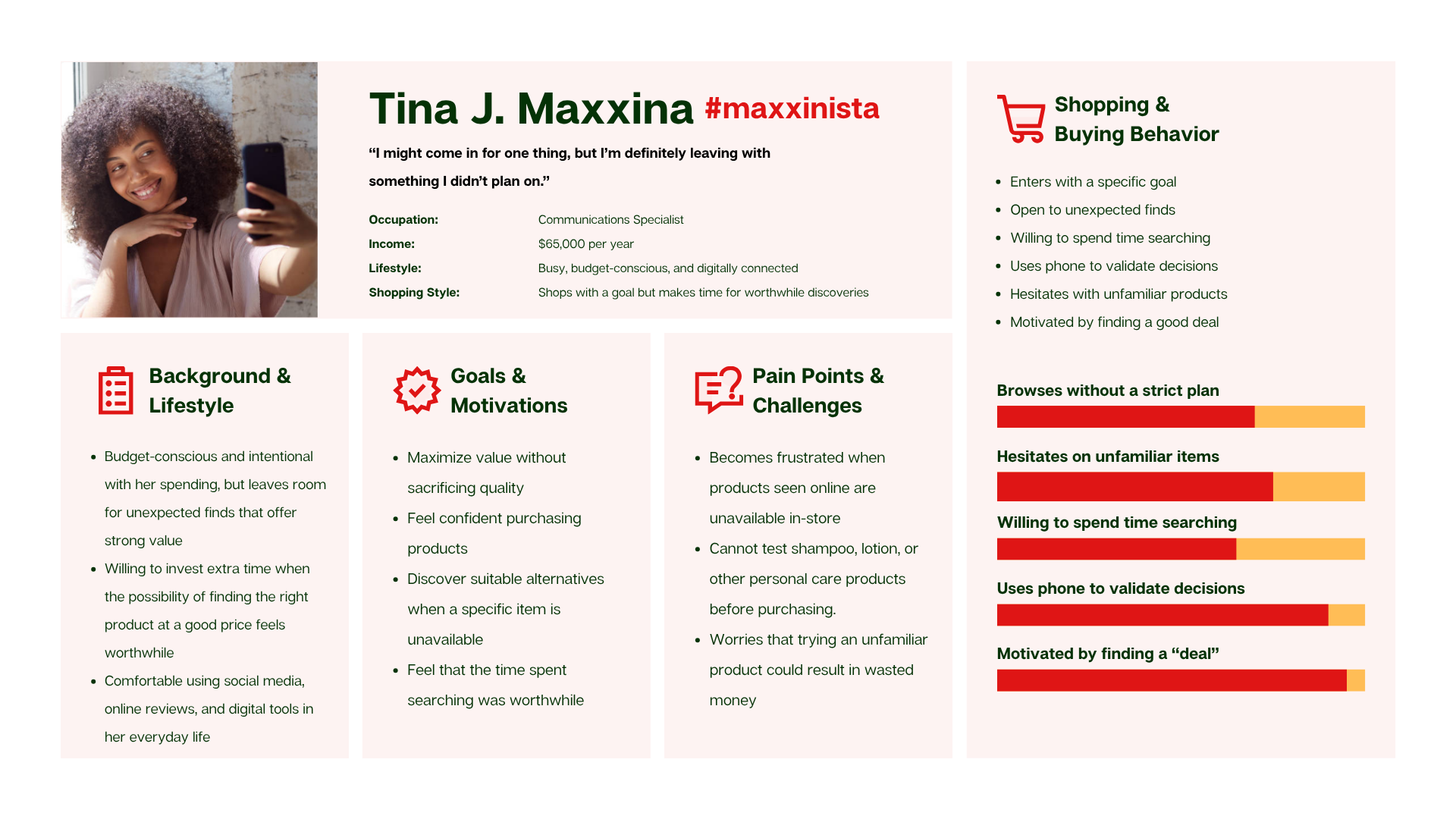
Meet Tina J. Maxxina, a representative TJ Maxx shopper whose goals, behaviors, and challenges reflect common patterns identified through our research.
Storyboards
I created these storyboards based on our research to illustrate two common shopping experiences: discovering an unexpected item and seeking validation before purchasing, or searching for a specific product and leaving frustrated when it cannot be found.
Insights
WHAT I EXPECTED
Because TJ Maxx has non-guaranteed inventory, I assumed that most shoppers were primarily hedonic—visiting simply for the joy of browsing and the excitement of not knowing what inventory there would be.

WHAT WAS FOUND
The research revealed a more nuanced picture. Shoppers often arrive with goals in mind while remaining open to unexpected discoveries, shifting fluidly between goal-oriented and exploratory shopping.
Key Insights
Treasure hunt shopping blends goal-oriented and exploratory behavior
Unlike what is typically seen in other hedonic shopping environments, shoppers may enter the store with a general category in mind, such as skincare, home décor, or clothing, while remaining open to unexpected finds. Even after locating an intended item, shoppers often continue exploring, reflecting a fluid shift between goal-oriented and exploratory behavior.
Shoppers use tools and comparisons to build purchase confidence
The findings suggest that digital and social tools play an important role in helping shoppers make purchase decisions at TJ Maxx. Shoppers often use their phones in-store to check reviews, compare prices, look at social media, and seek outside opinions to validate whether an item is right for them or represents a good deal.
Social media extends the treasure hunt beyond the store and motivates visits
For many shoppers, haul videos, trending products, and friends’ posts inspired them to visit TJ Maxx. Rather than shopping only out of immediate need, they were often motivated by anticipation and the chance to find something they had seen online. This suggests that social media extends the treasure hunt experience by building excitement and encouraging shoppers to seek discoveries in-store.
Unexpected discoveries are key to how shoppers define success
While browsing and discovery create engagement, purchase remains the key measure of success. Unlike purely hedonic shopping, where the experience itself may be the reward, many TJ Maxx shoppers judge a trip by whether their exploration leads to finding and purchasing a unique, high-value item.
Search persistence has a threshold
Search persistence is shaped by both time and perceived reward. When shoppers repeatedly fail to find a desired item or make a meaningful discovery, the experience can shift from engaging to frustrating, leading them to disengage or leave empty-handed—even among hedonic shoppers who typically enjoy the act of browsing alone.
Design Iterations
For the digital recommendation phase, each team member explored a solution direction. My concept was AI Shelf Scan, a feature that helps shoppers locate desired items or find similar in-stock alternatives by scanning store shelves.
Draft 1
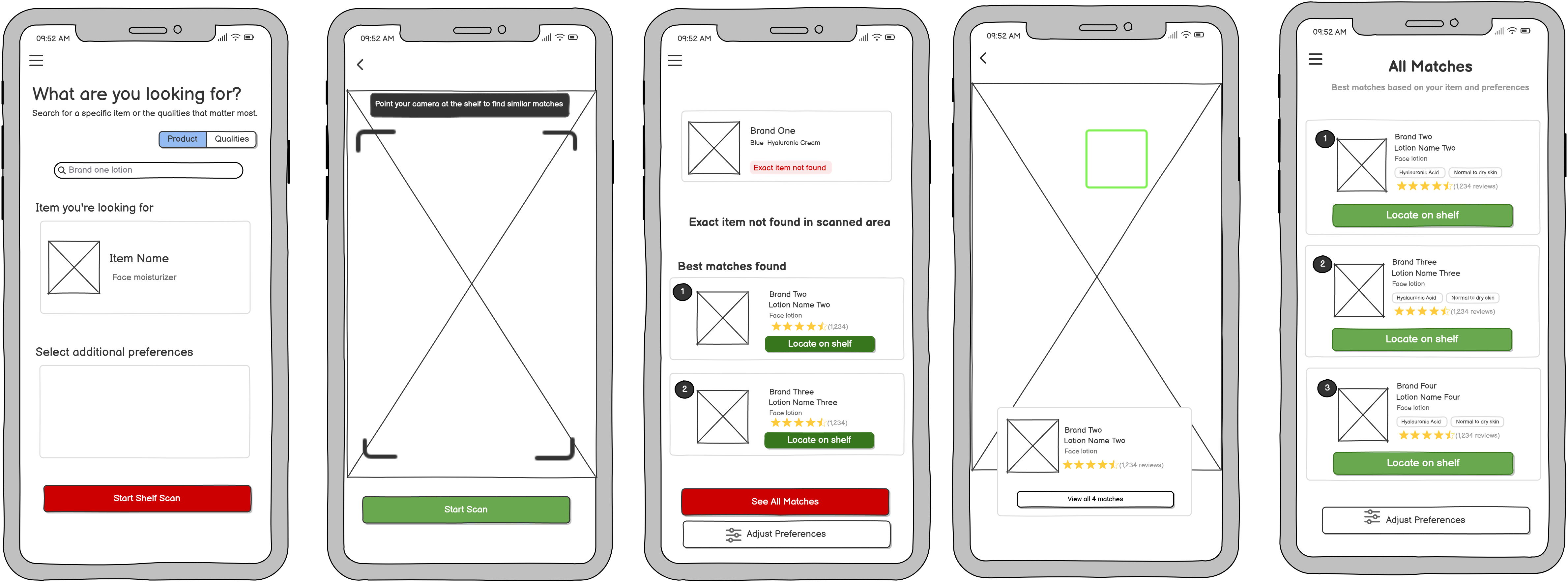
The first sketch explored the end-to-end AI Shelf Scan flow, from searching for a desired trending item to scanning the shelf and receiving similar in-stock recommendations when the exact product is not found.
Draft 2
The second pass refined the AI Shelf Scan flow with higher-fidelity screens, from searching for a desired item to scanning the shelf and receiving similar in-stock recommendations when the exact product is not found.
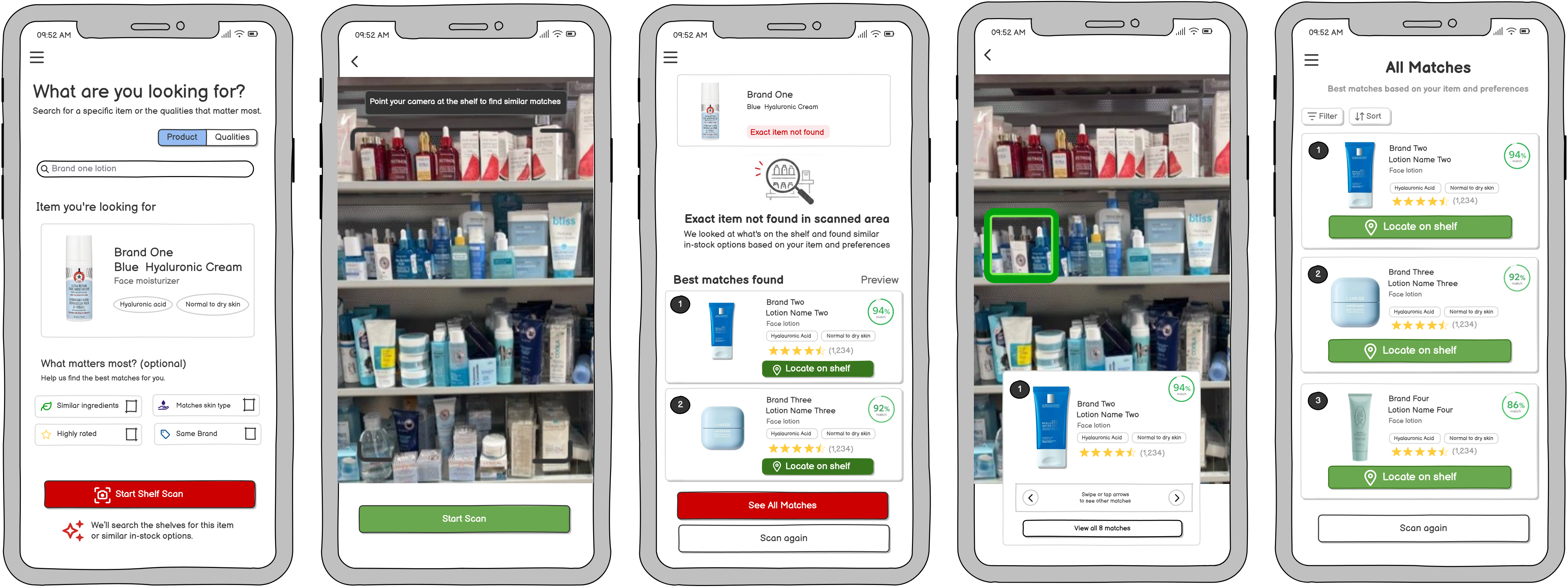
Final Design
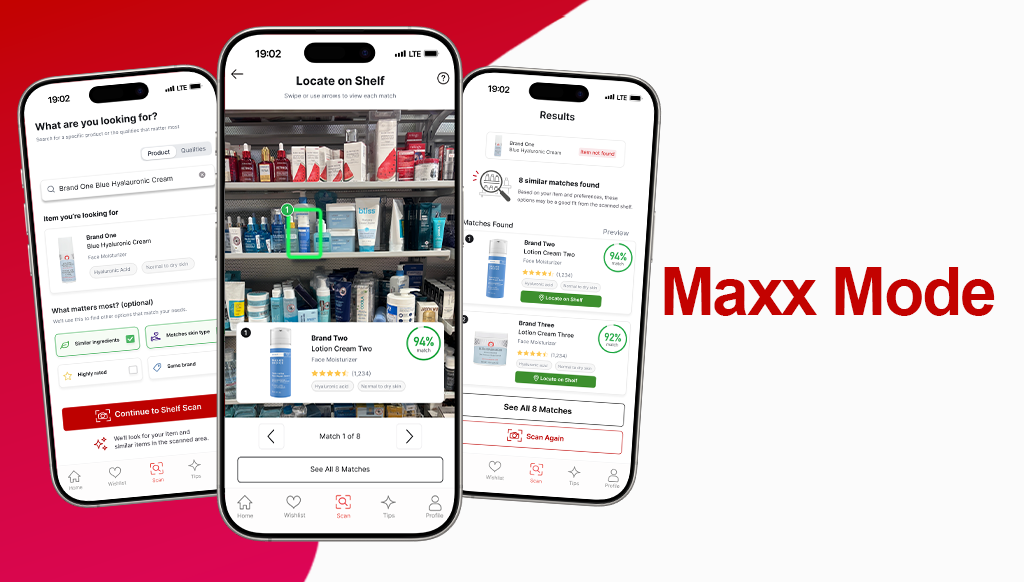
Based on our research, I designed AI Shelf Scan as a lightweight digital tool that supports the behaviors shoppers already use in-store, rather than replacing the treasure hunt experience. Field study findings showed that shoppers often rely on their phones, product comparisons, and reviews to build confidence before making a purchase. This feature extends that behavior by helping shoppers make sense of the products physically available in front of them.
With this AI shelf app, shoppers can enter a desired product, brand, ingredient, or quality, then scan a shelf to identify nearby in-stock options. Each result includes a match percentage, key product attributes, ratings, reviews, and shelf-location guidance. When a shopper is looking for a specific product that isn’t available, the tool also surfaces similar alternatives ranked by how closely they fit the shopper’s preferences. The goal is to reduce friction during comparison and decision-making while preserving the in-person exploratory nature of TJ Maxx shopping.
Final Design Highlights
Use the arrows to see some highlights for each screen.
Figma Prototype Video
This Figma prototype demonstrates the complete user flow for searching for a specific item, scanning the shelf for similar in-stock alternatives, and reviewing the results.